
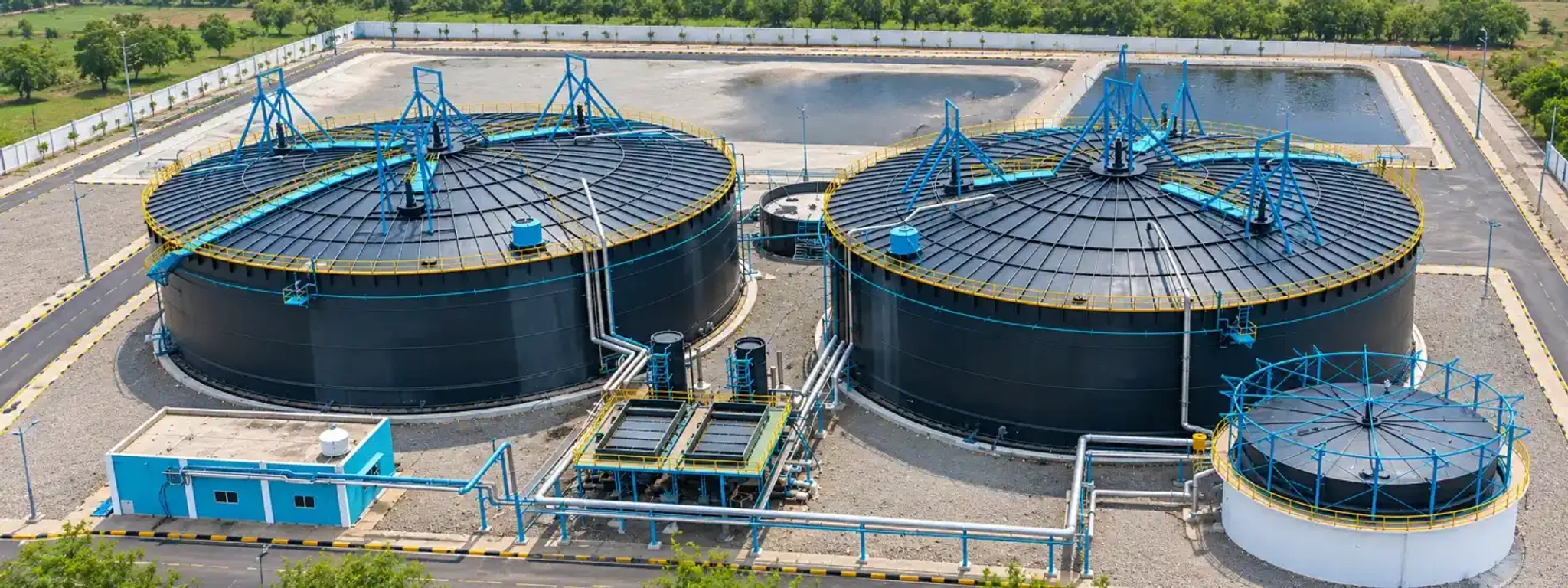
CSTR Anaerobic Digestion
Dry Digestion and CSTR Technology
High-torque, heavy-duty mixing technology built for continuous, reliable biogas production from liquid slurry, cow dung, poultry litter, press mud, spent wash, sewage and industrial effluent.
- Home
- Dry Digestion and CSTR Technology
Classification Basis
Anaerobic digestion technologies are generally selected based on the total solids (TS) content of the feedstock rather than a single, one-size-fits-all design. CSTR (Continuously Stirred Tank Reactor) and dry digestion sit at opposite ends of that spectrum.
CSTR — The Proven Core of Every Bharat Bioenergy Plant
The Continuously Stirred Tank Reactor (CSTR) is the world's most widely deployed anaerobic digestion technology, and it sits at the core of every Bharat Bioenergy CBG and biogas plant as our Combi Digester™ platform. It is engineered for pumpable, liquid organic feedstocks — liquid slurry, cow dung and poultry litter, along with press mud, spent wash, sewage and industrial effluent — diluted to a consistent, pumpable slurry.
Inside the tank, the substrate, bacteria and temperature are kept fully homogeneous through continuous mechanical agitation, so feeding and discharge can run around the clock rather than in stop-start batches. That continuous operation is what keeps gas output steady and predictable — the reason CSTR remains the standard technology of choice for commercial-scale CBG and biogas projects across India.
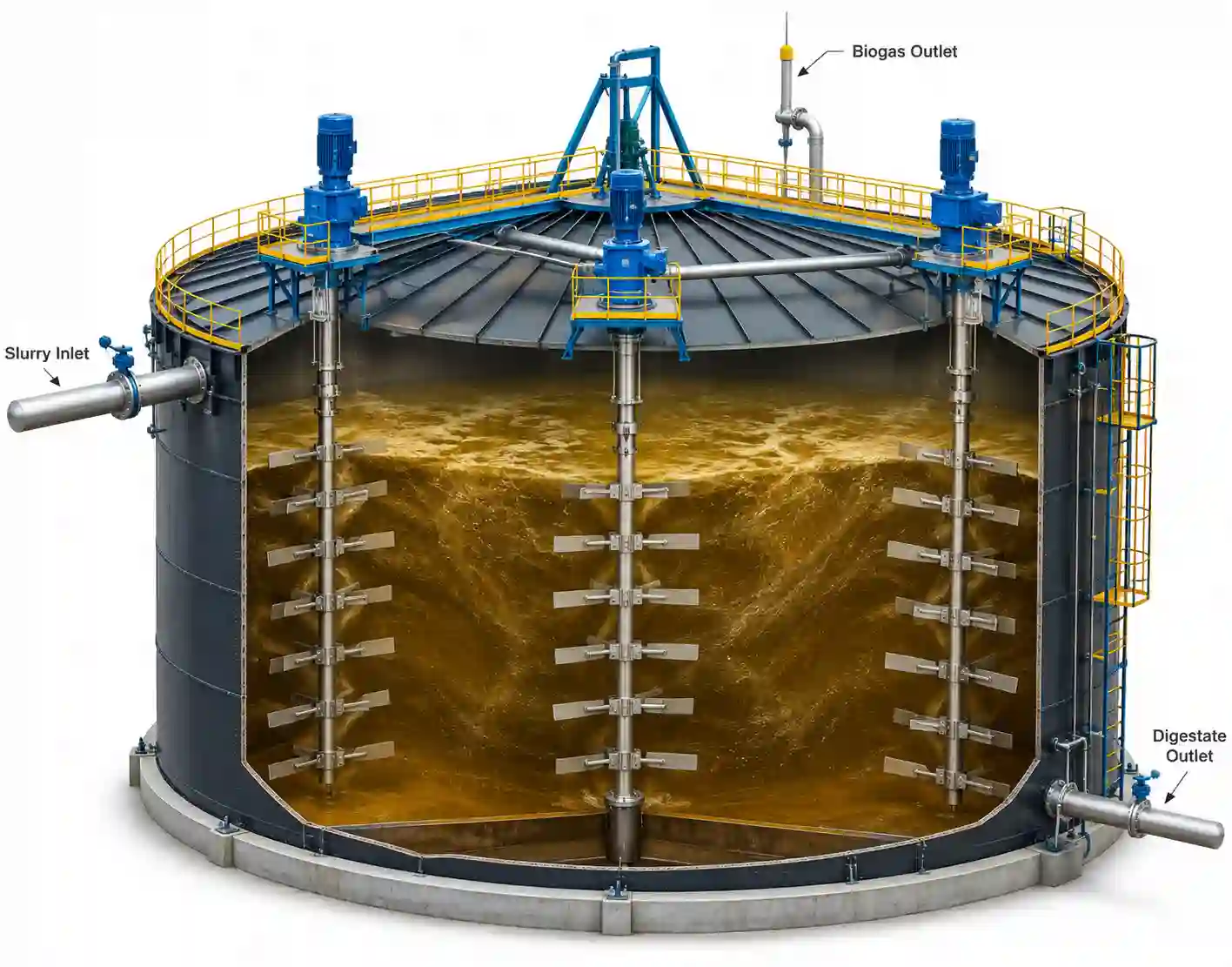
How Combi Digester™ Works
Feedstock Intake
Slurry, cow dung, poultry litter & other liquid organics.
Water Addition
Dilution to a uniform, pumpable consistency.
Agitator Mixing
Combi Digester™ high-torque mixing homogenises the tank.
Anaerobic Digestion
Continuous biogas generation.
Purification & CBG
H₂S scrubbing, upgradation, compression.
Water dilution and agitator mixing happen together at the head of the process — this is what keeps the digester fully mixed and prevents the settling, crusting and dead zones that reduce gas yield in poorly agitated tanks.
The trade-off with any liquid-fed CSTR is that dilution adds volume: every tonne of thicker feedstock that needs water to become pumpable increases the reactor size needed for a given retention time and the heating demand. Combi Digester™'s heavy-duty mixing is engineered to keep that trade-off in check by handling thicker slurries efficiently, reducing how much dilution water is actually needed.
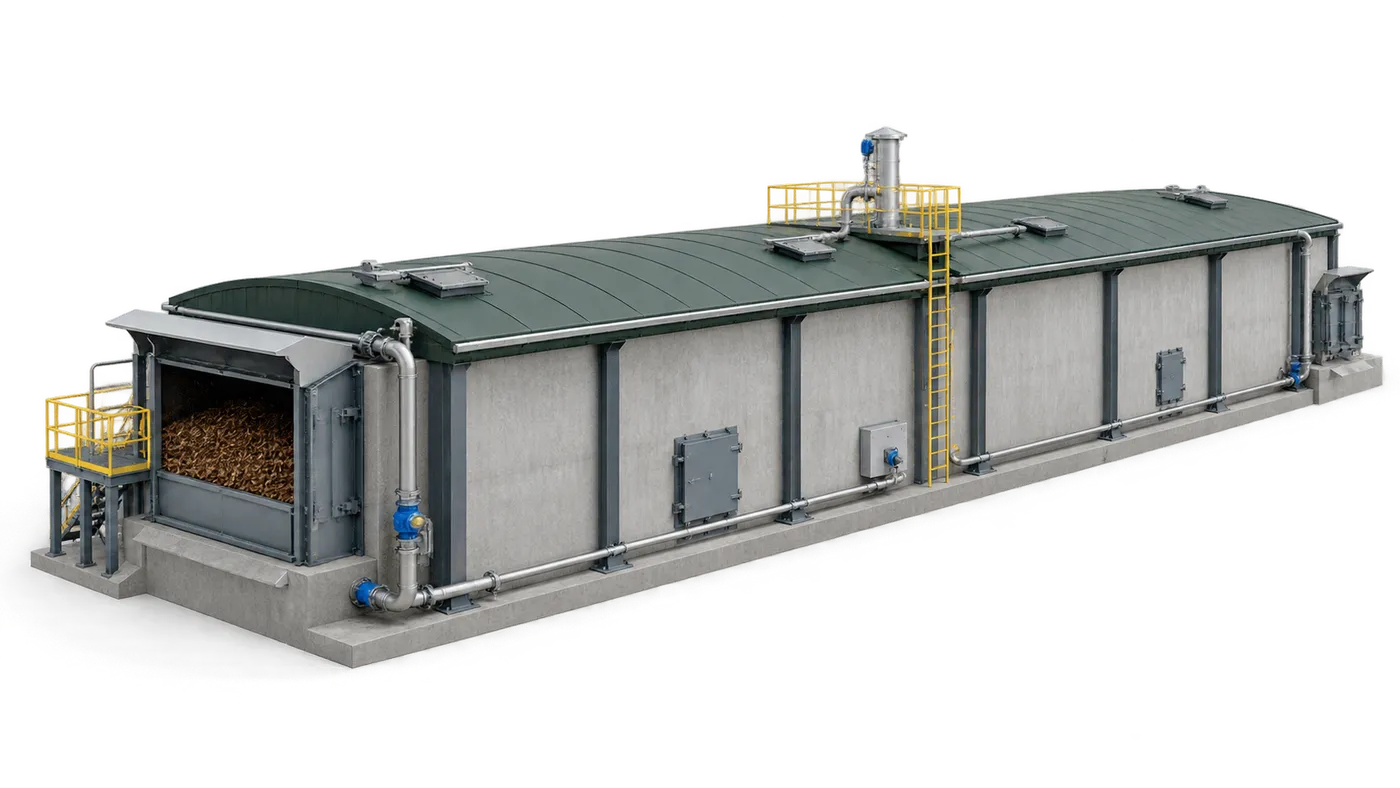
Dry Digestion
Dry digestion is built for feedstocks that are naturally solid or fibrous, with total solids typically in the 20–40% range — municipal solid organic waste, straw and crop residues, solid manure, silage, and other stackable biomass that cannot easily be pumped. There is no need to dilute the material with large volumes of water, keeping digestate output smaller and heating load lower per tonne of feedstock treated.
Dry systems come in two main configurations. Batch (garage- or box-type) systems load solid material into sealed, gas-tight chambers using a wheel loader, inoculate it by recirculating percolate/leachate collected at the base, and run a fermentation cycle of roughly three to four weeks before the chamber is emptied and reloaded; multiple staggered chambers keep overall biogas output continuous even though each individual chamber operates in batch mode. Continuous plug-flow dry digesters instead move the material horizontally through a long reactor using augers, rams, or gravity, with minimal internal mixing, so fresh feed pushes older, partially digested material along the length of the vessel.
Dry digestion needs less water and produces a smaller, more concentrated digestate, but depends heavily on mechanical handling equipment (loaders, augers, conveyors), runs in multi-week batch cycles rather than continuously, and is a comparatively newer, less standardised technology with fewer long-track-record suppliers than CSTR — which is why it is not part of Bharat Bioenergy's core technology offering.
Combi Digester™ CSTR Technology
Combi Digester™ is Bharat Bioenergy's in-house engineered CSTR platform. Rather than relying on a single mixer type, it matches the right mixing method to the feedstock and tank size — heavy-duty agitators for high-torque, low-speed mixing of thicker slurries, and pump-based recirculation where a lower-solids stream calls for it — all manufactured and serviced through our own Pune and Karnataka facilities.
Agitator-Based Mixing
Pump-Based Mixing
Why Combi Digester™ CSTR Is Bharat Bioenergy's Recommended Technology
For the feedstocks Indian CBG and biogas projects actually generate — liquid slurry, cow dung, poultry litter, press mud, spent wash, sewage and industrial effluent — CSTR is the simpler, proven, lower-risk technology, which is why it is the core of every plant we build.
Decades of Proven Operation
CSTR is the most widely deployed anaerobic digestion technology in the world, with a deep base of operating history, equipment suppliers and spare parts. Batch-type dry digestion has a far shorter, thinner track record at commercial scale.
Continuous Output, Not Batch Cycles
Combi Digester™ feeds and discharges continuously, so gas production stays steady day to day. Batch/dry systems load a chamber, run a multi-week cycle, then empty and reload it — adding downtime, manpower and scheduling risk around every cycle.
Matches Real Indian Feedstock Streams
Liquid slurry, cow dung, poultry litter, press mud, spent wash, sewage and industrial effluent are all pumpable, liquid-compatible streams that suit CSTR directly — without the shredding, drying or bulk mechanical handling that purely fibrous dry-digestion feedstock requires.
Simpler, Lower-Risk O&M
Pumps and standard mechanical agitators are easier to source, maintain and service locally than the specialised loaders, augers and gas-tight batch chambers dry digestion depends on.
Backed by In-House Manufacturing
Because CSTR is a standardised, well-understood technology, Bharat Bioenergy manufactures and services the core Combi Digester™ equipment in-house at Pune and Karnataka — giving full control over quality, lead time and long-term support.
Trusted by Leading Sugar & Bio-Energy Producers
Bharat Bioenergy & Renewable membrane CO₂ removal and CBG solutions are trusted by leading sugar and bio-energy producers, including:
Representative client list.