

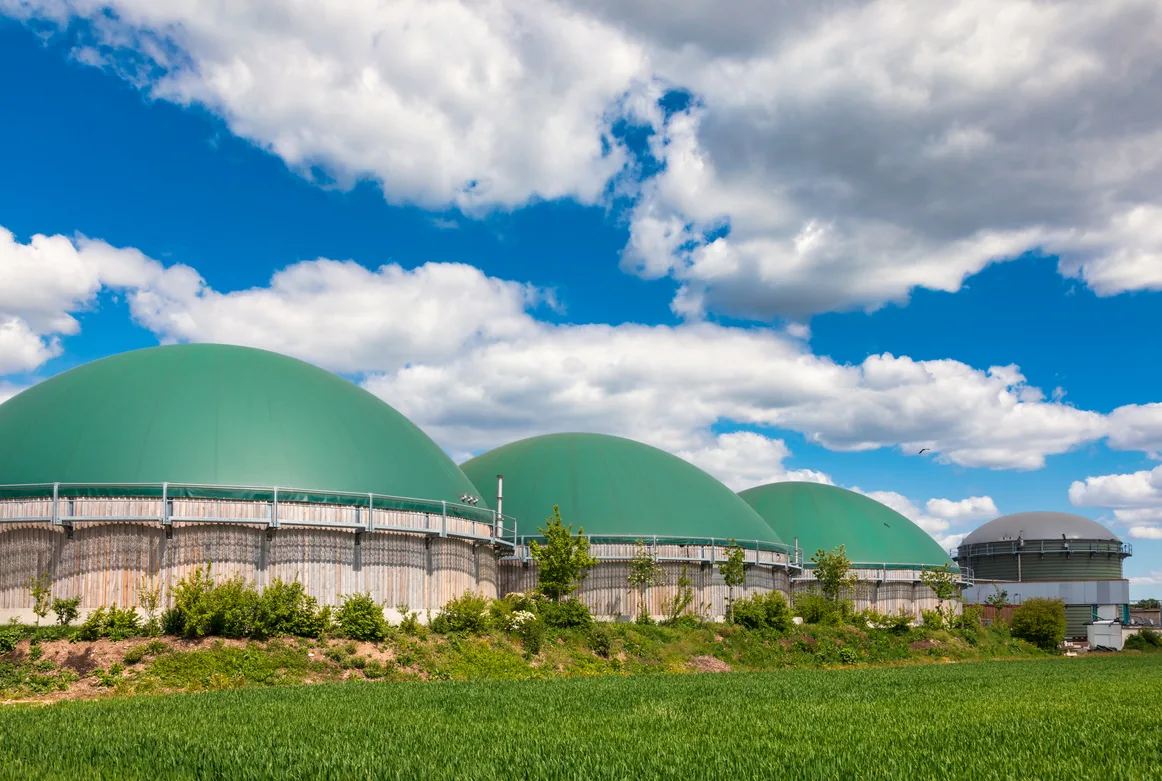
CBG is biogas that's been cleaned up and pressurized to the point where it works as a fuel. The starting material is organic waste, and there's a lot of it to choose from. Cattle dung, municipal solid waste, sewage sludge, sugar mill press mud, and kitchen waste, pretty much any of it will do. Seal that waste in a tank with no oxygen and bacteria go to work on it over several weeks. That's anaerobic digestion, and what comes out is a gas mixture called raw biogas.
Raw biogas is only about 50 to 70 percent methane. The rest is mostly carbon dioxide, plus small traces of hydrogen sulphide and moisture. Too weak, too impure, no good for running a vehicle as-is. A purification stage fixes that by stripping out the CO2, H2S, and moisture until methane content climbs past 90 percent. What's left afterward is compressed biogas, close enough to CNG that it gets used the exact same way.
That's really the whole idea in one line: raw biogas turns into CBG once the impurities are gone and it's compressed to fuel-grade.
How CBG Gets Made
The process breaks down into a few steps, and the order rarely shifts from one plant to another.
It starts with collecting whatever organic waste is around locally. Paddy straw, dung, food waste, press mud, sometimes a purpose-grown crop like Napier grass. That material then sits in airtight digesters for weeks while bacteria break it down, and two things come out the other end. There's raw biogas, obviously, but also a leftover slurry called digestate, which happens to make a decent organic fertilizer on its own.
The raw biogas still needs cleaning up at this point. Water scrubbing, pressure swing adsorption, membrane separation, chemical scrubbing, different plants pick different technologies, but they're all after the same outcome, stripping CO2, H2S, and moisture out until methane crosses that 90 percent mark.
Once purified, the gas gets compressed, usually somewhere around 250 bar. From there it either goes into cylinders and cascades for transport, or straight into a pipeline network.
Worth mentioning here: that leftover digestate can be processed further into Fermented Organic Manure, or FOM, and sold as bio-fertilizer. Plant operators end up with a second income stream sitting right alongside the gas sales, which isn't nothing.
What CBG Needs to Contain: The IS 16087 Standard
CBG can't just get sold to Oil Marketing Companies or pushed into a City Gas Distribution network however a plant likes. It has to meet IS 16087, the spec the Bureau of Indian Standards laid down.
| Characteristic | Requirement (IS 16087:2016) |
|---|---|
| Methane (CH4), minimum | 90.0% |
| Carbon Dioxide (CO2), maximum | 4% |
| CO2 + N2 + O2 combined, maximum | 10% |
| Oxygen (O2), maximum | 0.5% |
| Total Sulphur (incl. H2S), maximum | 20 mg/m³ |
| Moisture, maximum | 5 mg/m³ |
The gas also has to stay free of liquids and particulates across whatever temperature and pressure range it hits in storage and dispensing. Supply to retail outlets typically happens at 250 bar.
How CBG Stacks Up Against CNG
| Parameter | Compressed Biogas (CBG) | CNG |
|---|---|---|
| Source | Organic waste | Fossil natural gas |
| Methane content | 90%+ | 95%+ |
| Renewable | Yes | No |
| Vehicle fuel use | Yes | Yes |
On paper, these two line up closely enough that CBG can be blended with CNG, or used in its place outright, whether that's in vehicles, industrial burners, or the CGD network. No infrastructure changes needed, no engine swaps. Raw biogas doesn't get that same treatment. Sitting at 50 to 70 percent methane, it still needs upgrading before it earns the fuel-grade label. PNG, meanwhile, isn't really in the same conversation. It's fossil gas piped into homes and factories, never compressed for a vehicle.
Where the Feedstock Comes From
Most CBG plants in India run on some mix of sources rather than just one. Agricultural residue, paddy straw and crop stubble especially, tends to dominate in farming-heavy states. Cattle dung shows up often too, alongside municipal solid waste and sludge pulled straight from sewage treatment plants. Sugar mills add press mud to the pile, food and vegetable markets contribute their own waste, and in a handful of regions, energy crops like Napier grass get grown specifically to feed a digester.
Availability swings a lot from one region to the next, so plant design usually blends two or three sources instead of betting everything on one. Keeps supply steady through the year, and that matters more than it might sound like it does on paper.
Why It's Worth Caring About
The environmental case gets most of the attention, and that's fair. Pulling crop residue and municipal waste away from open burning and landfills cuts down on stubble-burning smoke, plus the methane that decomposing waste would otherwise send into the air anyway. But the argument for CBG doesn't stop at emissions, not by a long shot.
There's the energy angle too. It chips away at India's reliance on imported natural gas and LPG by building up a fuel supply grown domestically, quite literally, out of waste bins and farm fields. Farmers get a buyer for residue and dung that would otherwise sit unused, plus access to a fertilizer by-product that can genuinely help soil health over time. For whoever's running the plant, the math is straightforward enough: a waste stream that used to cost money to get rid of turns into revenue instead, and it does that twice over, once from gas and once from fertilizer.
The SATAT Scheme's Role in All This
A good chunk of the momentum behind CBG in India traces back to SATAT, Sustainable Alternative Towards Affordable Transportation, a scheme the Ministry of Petroleum and Natural Gas rolled out back in October 2018. Oil Marketing Companies like IOCL, BPCL, and HPCL invite entrepreneurs under this scheme to set up CBG plants, offering a Letter of Intent and a long-term offtake agreement as the carrot.
That framework has only gotten stronger since. A blending obligation now forces a rising share of CBG into the CNG and PNG flowing through the City Gas Distribution (CGD) network, pushing the whole system from voluntary toward something closer to mandatory. Throw in revised procurement pricing and a wider set of subsidies, and CBG plants look like a considerably better bet today than they did back in SATAT's early years. Probably explains why investor interest keeps climbing the way it has.
Where CBG Actually Gets Used
Vehicles are the most visible use case. Buses, cars, and commercial fleets running on CBG instead of, or blended with, CNG. Industry leans on it too, in boilers, furnaces, and other thermal equipment, swapped in as a direct replacement for fossil fuel. Some CBG gets injected into CGD pipelines for homes and businesses, and the remainder heads to power generation, feeding stationary engines and generators.
Frequently Asked Questions
The Bottom Line
Compressed biogas takes what used to be a disposal headache, agricultural stubble, cattle dung, municipal waste, and turns it into fuel and fertilizer instead. Emissions drop, farmers pick up another income stream, and India's dependence on imported fossil fuels erodes a little more, all while running on the same CNG infrastructure the country has already built. Blending mandates keep expanding, so this isn't a topic that fades after one policy cycle. Businesses, investors, and policymakers will all keep needing to understand it for a while yet.
Thinking about setting up a compressed biogas plant for your business or municipality? Bharat Bioenergy & Renewable handles turnkey CBG plant and biogas EPC projects end-to-end. Get in touch to talk through your project.

Leave a Comment